Home Guide
Can Water-Damaged Hardwood Floors Be Saved?
Cupping, crowning, buckling — water-damaged hardwood doesn't always mean replacement. Learn what can be saved, what can't, and how fast drying makes the difference.
Updated March 7, 2026 · Water Damage Restoration Salt Lake City
Dealing with water damage right now? Don't wait — mold starts in 24 hours.
Call (435) 485-9530Hardwood floors are one of the most expensive things water can ruin in a home — and one of the most salvageable, if you act fast. Whether your floor can be saved comes down to how much water, how long it sat, and how quickly proper drying began.
How water damages hardwood
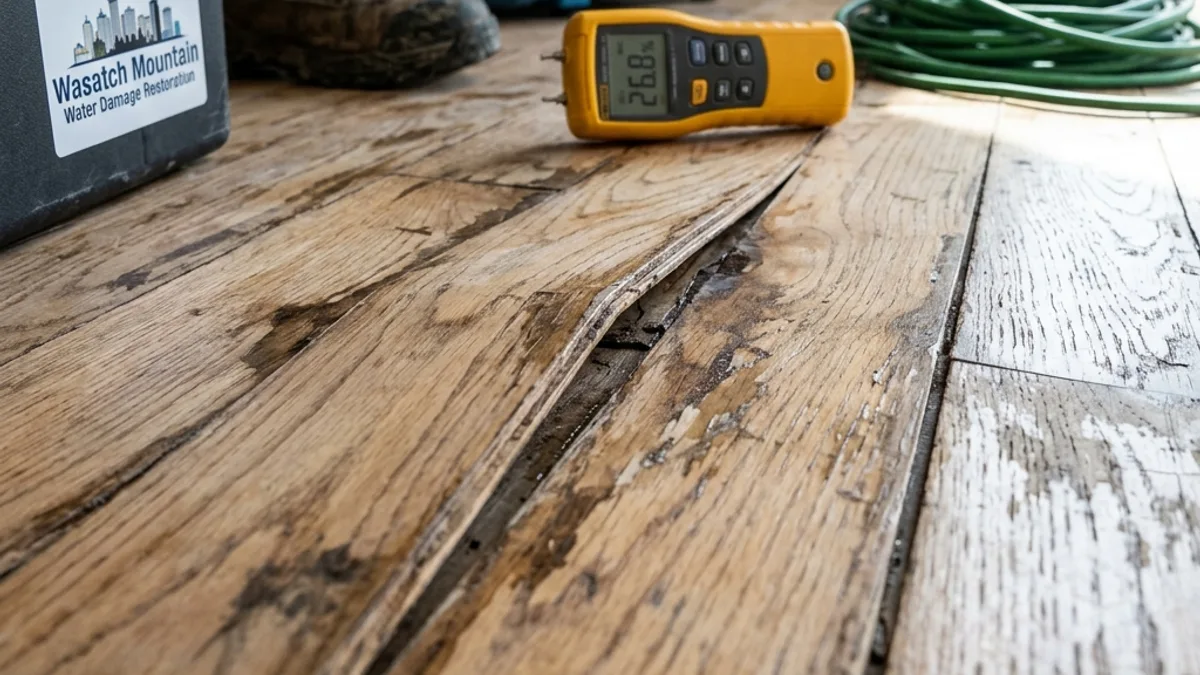
Wood is hygroscopic — it absorbs and releases moisture. When it soaks up water, it swells; as it dries unevenly, it distorts. You’ll see this as:
- Cupping — board edges rise higher than the centers
- Crowning — the center rises above the edges (often after improper drying)
- Buckling — boards lift completely off the subfloor (severe)
- Staining and discoloration — dark spots where water and minerals penetrated
- Gaps or warping as boards shift
The faster you start structural drying, the more likely the wood returns to shape before permanent damage sets in.
What can usually be saved
- Minor cupping caught early often flattens back out with controlled drying, then a light sanding and refinish.
- Surface staining can sometimes be sanded out during refinishing.
- Solid hardwood is more recoverable than engineered, because it can be sanded multiple times.
What usually can’t
- Buckled boards that have lost their bond to the subfloor
- Engineered wood whose top veneer has delaminated
- Floors over a saturated subfloor that itself must be replaced
- Anything contaminated by category-3 black water
Wood floor took on water?
The first 24–48 hours decide if it can be saved. Fast professional drying is your best shot.
Why speed and proper drying matter so much
Here’s the part homeowners miss: hardwood can look fine on top while the subfloor beneath stays soaked. If you only dry the surface, the trapped moisture keeps distorting the wood and breeds mold. And drying hardwood too aggressively causes its own damage (crowning, cracking). It needs a controlled rate — which is exactly what professional drying equipment and moisture monitoring provide. This is a perfect example of why DIY drying, covered in our structural drying guide, so often fails.
The professional process for water-damaged hardwood
- Moisture mapping of boards and subfloor to find every wet area.
- Extraction of standing water and specialized floor drying systems that pull moisture from between boards and the subfloor.
- Controlled drying monitored daily to avoid over- or under-drying.
- Assessment of which boards recovered and which need replacement.
- Refinishing — sanding and resealing to restore the surface.
Timing varies with the severity — see how long water damage restoration takes for realistic expectations.
Cost and insurance
Saving a floor is almost always cheaper than replacing it, which is why fast drying pays for itself — see our cost guide. If the damage came from a sudden event like a burst pipe, it’s frequently covered; our insurance claim guide walks through documentation.
The bottom line
Don’t write off your hardwood the moment it gets wet — but don’t wait, either. With fast extraction and controlled professional drying, many water-damaged floors recover beautifully. The longer the water sits, the more the odds shift toward replacement. We help homeowners across Salt Lake City and the valley give their floors the best possible chance.
Need Help? Request a Free Assessment
Tell us what happened and a licensed Salt Lake City restoration specialist will get right back to you.